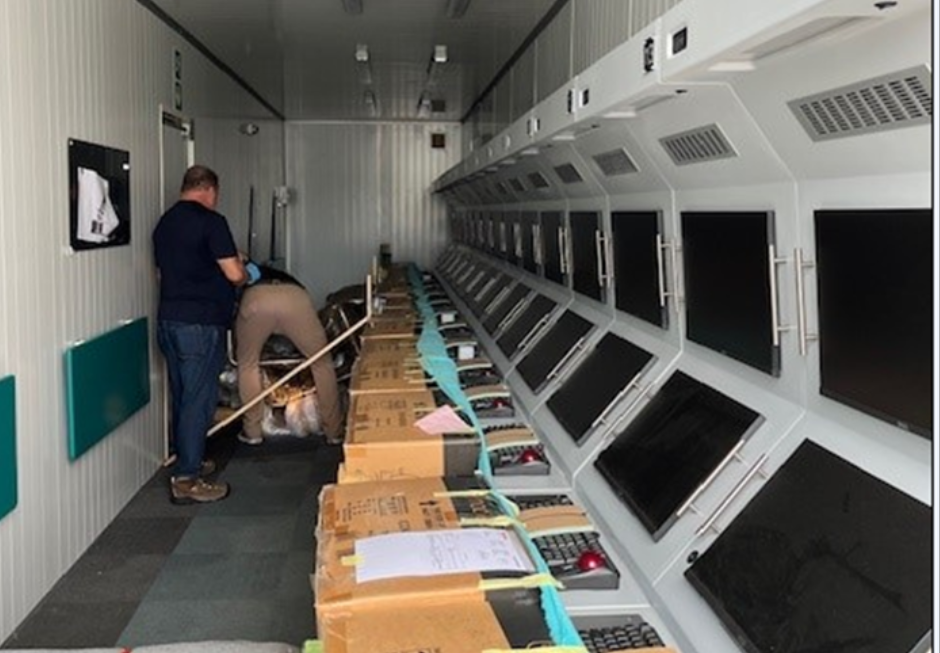
JOHANNESBURG — The United States Department of Justice has moved to seize two pieces of military training equipment intercepted while being shipped from South Africa to China, a step Pretoria-linked sources view as part of Washington’s broader campaign to police global technology flows and constrain China’s rise.
In a civil forfeiture action filed this week, U.S. authorities allege that the equipment — mission crew trainers (MCTs) originating from the Test Flying Academy of South Africa (TFASA) — could have enhanced China’s military capabilities, particularly in submarine tracking and airborne surveillance operations.
According to U.S. court filings, the trainers were allegedly destined for China’s People’s Liberation Army and were said to have been built using U.S.-origin software and sensitive defence-related technology without the required American export authorisation. Washington claims the equipment resembled training systems associated with the P-8 Poseidon, a U.S.-manufactured maritime patrol aircraft used primarily for anti-submarine warfare.
U.S. prosecutors further allege that the project, internally referred to as “Project Elgar”, aimed to support the training of Chinese crews to detect and track U.S. submarines operating in the Pacific, a claim that South African officials and the company involved have firmly rejected.
American law enforcement agencies, including the FBI and Homeland Security Investigations (HSI), defended the seizure as necessary to safeguard U.S. national security, arguing that the transfer of advanced training systems could erode America’s military advantage and place its service members at risk.
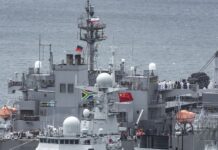
The move comes against the backdrop of heightened geopolitical tensions, including recent naval exercises involving China, Russia and Iran in waters near South Africa — activities that have drawn sharp scrutiny from Washington but which Pretoria has consistently defended as lawful and non-aligned.
TFASA has categorically denied the allegations, dismissing claims that it exported NATO aviation expertise or U.S. military technology in violation of international regulations. In a detailed statement, the company said the seized containers held only non-sensitive, mobile classroom units designed for mission crew training focused on crew resource management in maritime patrol aviation.
“These systems were not tactical simulators and did not include advanced, classified, or mission-specific military capabilities,” the company said. TFASA stressed that the equipment relied exclusively on publicly available information and commercially licensed software intended for procedural and instructional use.
The firm further rejected assertions that the trainers incorporated U.S. defence technology or export-controlled material, stating that the equipment and associated software had been reviewed and vetted by relevant authorities prior to shipment. According to TFASA, this process confirmed the absence of any restricted or sensitive technology.
“The shipment was conducted lawfully and transparently, with no attempt to conceal its nature or purpose,” the company said, adding that while it anticipated heightened international scrutiny, it had acted in good faith and in full compliance with applicable laws.
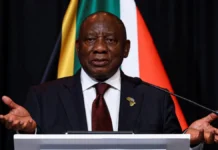
South Africa’s Department of International Relations and Cooperation (DIRCO) said it was engaging the United States through diplomatic channels to clarify the matter. Spokesperson Chrispin Phiri reiterated Pretoria’s commitment to constructive dialogue while emphasising the importance of an accurate and balanced understanding of the facts.
Analysts say the case reflects growing U.S. efforts to extend its export-control regime beyond its borders, often placing developing countries — including non-aligned states such as South Africa — at the centre of great-power competition. For Pretoria, the dispute underscores ongoing tensions between its sovereign right to conduct lawful trade and Washington’s increasingly expansive interpretation of national security.